
Last updated November 2, 2026
 Wrought iron
 Wood & steel frame
 Farm & ranch
 Sliding driveway gates
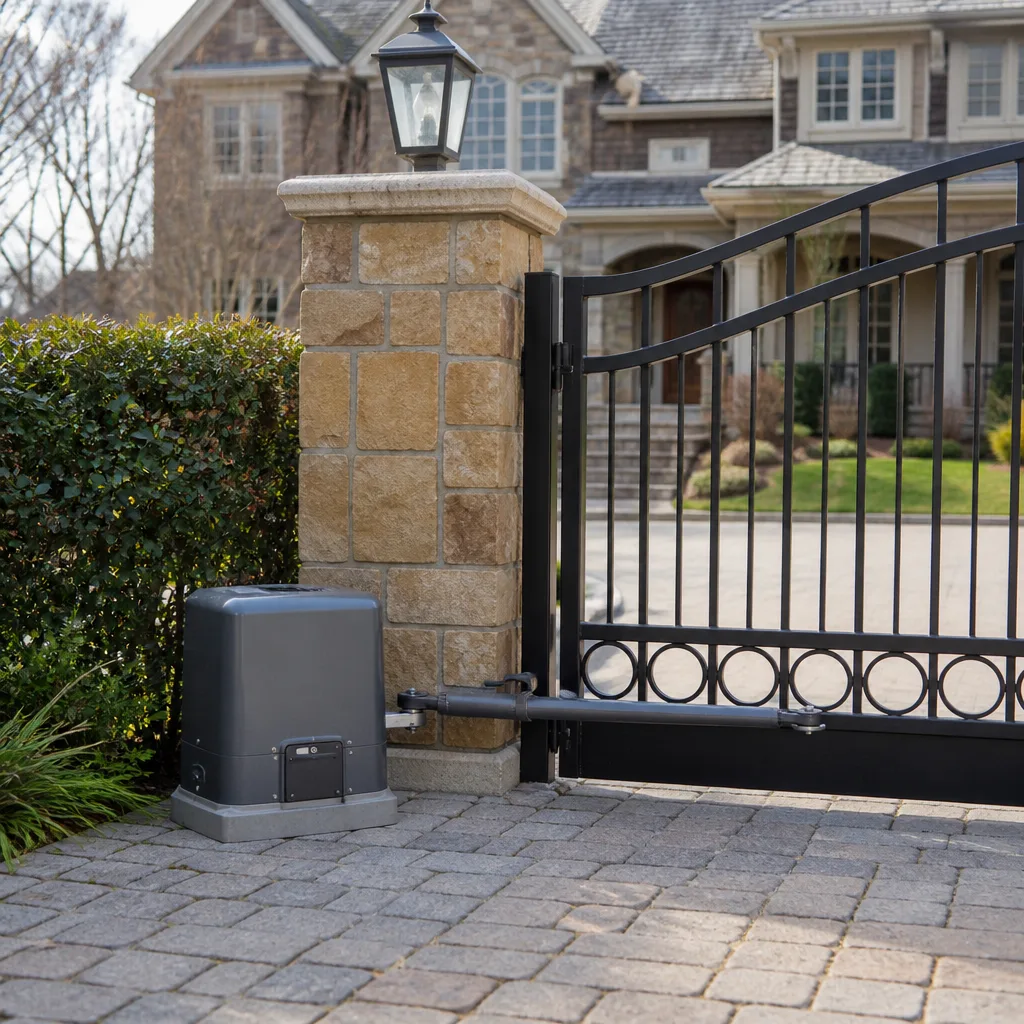 LiftMaster operators
Free on-site gate assessment - hinges, posts, and your LiftMaster or Nice gate operator checked before anything is quoted
The assessment is free and the quote is the invoice.
Get your free estimateGate Repair Warning Signs: A Valencia Homeowner’s Reference Guide
Here’s something most Valencia homeowners learn the hard way: the gate that hesitates for two seconds before it moves isn’t “warming up.” It’s a control board or capacitor showing early failure. You typically have 30 to 90 days before it stops working completely, usually at 7 a.m. on a Monday when you’re already late. This guide maps every warning sign your gate gives you, from the subtle to the obvious, directly to the component that’s failing and the repair window you have before it becomes an emergency that requires our Gate Repair services. We’ve built this from years of diagnosing gates across Valencia, from the ranch-style properties in Sand Canyon to the gated communities off McBean Parkway.
Styles & brands we work with
- Wrought iron
- Wood & steel frame
- Farm & ranch
- Sliding driveway gates
- LiftMaster operators
Quick Answer
The most common gate repair warning signs in Valencia are delayed movement (two seconds or more before the gate responds), grinding or clicking sounds during operation, intermittent failure to open or close, sagging gate panels, and remotes that work inconsistently. Any of these means a component is actively failing. The repair window ranges from same-day for safety sensors to a month or two for early motor wear, and catching symptoms early typically costs $150 to $450 instead of $1,200 to $2,800 for a full motor or control board replacement.
Table of Contents
- Sound-Based Diagnosis: What Your Gate Is Trying to Tell You
- Movement-Based Diagnosis: Hesitation, Jerking, and Reversed Direction
- Visual Indicators That Aren’t Obvious Damage
- Remote and Keypad Symptoms: Receiver, Battery, or Programming Corruption
- The Urgency Triage: Call This Week, Schedule Sometime, or Emergency Now
- Brand-Specific Failure Patterns We See in Valencia
- Valencia-Specific Factors That Accelerate Gate Wear
- Common Mistakes to Avoid
- When to Call a Professional
- Frequently Asked Questions
- The Bottom Line
Sound-Based Diagnosis: What Your Gate Is Trying to Tell You
Gates make noise. Some of it is normal: the low hum of a motor doing its job, the soft click of a limit switch engaging. But specific sounds map to specific failures with surprising accuracy. In Valencia, where gates run hundreds of cycles a month on busy residential streets and HOA entrances, sound is often the first diagnostic tool we use over the phone. Here’s what each sound means at the component level.
Grinding or metal-on-metal scraping
This is mechanical, not electrical. Grinding almost always means a bearing is failing or a drive gear has lost lubrication and is chewing itself apart. On slide gates, it’s typically the drive chain or the roller trucks underneath the gate. On swing gates, it’s the hinge bearings or the linear actuator screw. You’ll hear it most clearly at the start and end of travel, when the motor is under the most load. Left alone, the grinding components wear until the gate binds completely, and at that point the motor burns out trying to move a gate it can no longer turn. A bearing replacement runs $120 to $280. A motor replacement after the bind is $800 to $1,600. That’s the math behind “catch it early.”
Clicking without movement
A rapid clicking sound when you press the remote or keypad, with the gate not moving at all, points to one of three things. Most commonly: the capacitor on the motor has failed, so the motor can’t get the starting voltage it needs. Second: the control board’s relay is firing but the motor isn’t receiving power, which means a wiring fault or a failed motor winding. Third: the limit switch is stuck in the “already open” position, so the board thinks there’s nothing to do. The capacitor is the cheapest fix of the three, typically $80 to $180 including the part. The control board is the most expensive, typically $350 to $900 depending on brand. The diagnostic step matters because the symptoms are identical.
Humming without movement
A sustained hum with zero movement means the motor is receiving power but cannot turn. This is the classic seized-motor or failed-start-capacitor signature. On Mighty Mule and Ghost Controls residential systems, which use DC motors with internal capacitors, the hum is often quieter and easier to miss. On commercial-grade BFT or Linear operators, it’s louder and more obvious. If you hear this, stop pressing the remote. Repeated attempts overheat the motor windings and can turn a $150 capacitor replacement into a $1,100 motor swap. In our experience across Valencia, the homeowners who call after the first hum save themselves roughly $900 on average.
Movement-Based Diagnosis: Hesitation, Jerking, and Reversed Direction
How a gate moves tells you more than how it sounds. The movement signature, the delay, the speed, whether it pauses mid-travel, maps directly to specific component health. This is the section where most homeowners miss early warnings, because a gate that “moves a little slow” doesn’t feel like a breakdown in progress. It is.
Delayed response after remote press
We opened with this one. A gate that pauses two to five seconds before responding to a remote or keypad command isn’t normal, and it isn’t “warming up.” That delay is the control board’s processor taking longer than it should to execute the command, or a relay that’s arcing internally and making intermittent contact. On residential systems with plug-in control boards, like the entry-level models from Mighty Mule and Ghost Controls, the capacitors on the board degrade in Valencia’s summer heat and the delay gets progressively longer. You have weeks to a few months at most once the delay passes two seconds. The fix is usually a control board replacement at $250 to $600, and it’s a job we complete same-day in most cases because the diagnostic is straightforward.
Jerky movement or inconsistent speed
If your gate stutters, lurches, or moves fast then slow then fast, you’re looking at one of three component problems: a failing capacitor that cannot deliver smooth power, a drive gear with worn teeth that binds at a specific point in its rotation, or a control board sending inconsistent voltage. The worn gear is the one to catch early, because once the gear strips completely, the motor spins freely but the gate doesn’t move, and the repair is a full gearbox replacement at $300 to $800 rather than a preemptive gear replacement at half that. On slide gates, jerky movement can also mean debris in the track. Valencia’s wind picks up a lot of dust and leaves, especially in the fall along the paseos, and track cleaning is a $95 maintenance item that prevents the $600 repair.
Reversed direction mid-travel
When a gate starts opening and then reverses and closes, or starts closing and then reopens, that’s usually a safety sensor or safety edge being triggered. The system thinks something is in the path. Sometimes something is, leaves, a trash can, a child’s bike. But in Valencia we regularly see this pattern with clean, clear gate paths, and that points to a failing photo-eye sensor or a safety edge with a worn internal contact strip. The sensor misreads and signals an obstruction that isn’t there. This one is a genuine safety issue, because a gate that behaves unpredictably can close on a car or a person. Same-day service is warranted. The sensor replacement is typically $150 to $350.
Partial travel: opens halfway or closes partway
A gate that moves but stops short is a limit switch problem. The limit switch tells the motor where “open” and “closed” are. When it fails, gets dirty, or gets knocked out of adjustment, the gate stops wherever the switch falsely signals. The fix is often an adjustment or a $50 to $150 switch replacement, not a motor issue at all. But the symptom scares people, because a gate that won’t close all the way is a security problem. On Valencia properties with street-facing gates, a partially open gate is an invitation. Don’t manually force the gate to close, you’ll wear the gears and possibly damage the limit switch further. Call for diagnosis instead.
Visual Indicators That Aren’t Obvious Damage
Some of the most expensive gate failures in Valencia announce themselves visually, but not in the ways homeowners expect. No one ignores a bent gate post or a snapped hinge. The problems that get missed are the subtle ones: rust that follows a specific pattern, hairline cracks in the wrong place, a sag angle that changes by a degree or two a month. Here’s what to look for.
Rust patterns, not rust spots
Surface rust on a gate is cosmetic in Valencia’s dry climate. But rust that follows a seam, a weld line, or a bolt hole is structural. It means water has found a path inside the gate frame or the post, and it’s working from the inside out. The gate looks fine until it doesn’t. The classic case in Valencia is the weld where the gate frame meets the hinge plate. You’ll see a fine rust line tracing the weld. That weld is fatiguing. In six to eighteen months, the gate will crack there and either bind or fall. The fix is a re-weld and reinforcements, typically $200 to $500 if caught before the crack opens. After the crack, it’s a gate panel replacement at $1,500 to $4,000 depending on size and material.
Hairline cracks in concrete posts or pillars
Valencia’s soil is expansive in places, the clay swells and shrinks with moisture, and gate posts set in concrete are subject to slow ground movement. A hairline crack running vertically down a post or support pillar is often the first sign. It means the post is flexing, which puts uneven load on the gate hinges, which accelerates bearing wear, which eventually binds the gate. The crack itself is repairable with epoxy injection and possibly additional anchoring. The post replacement, if the crack widens past 1/8 inch or the post visibly leans, is a $1,800 to $4,500 structural job. Track the crack with a pencil mark. If it grows, act.
Sag angle on a swing gate
Stand at the hinge side and sight down the top rail of a closed swing gate. It should be level. If the latch side is a quarter inch lower than the hinge side, the gate is sagging. Every swing gate sags eventually, the weight of the gate works against the hinges constantly. But the rate of sag tells you whether it’s normal wear or hinge failure in progress. A gate that has sagged a quarter inch over five years is normal. A gate that sags a quarter inch in three months has failing hinge bearings or a post that’s moving. The repair differs significantly: bearing replacement is $180 to $350; post resetting is $1,200 to $2,500. A gate that sags enough to scrape the ground or no longer latches is a security issue that needs attention within days, not weeks.
Remote and Keypad Symptoms: Receiver, Battery, or Programming Corruption
When the remote stops working, the assumption is the remote broke. Often it’s not the remote at all. The receiver, the control board’s RF module, is the component doing the work, and it fails more often than the handheld remote does. Here’s how to read the symptoms so you replace the right $50 part instead of the wrong $400 one.
Remote works sometimes, from some distances
You’re in the driveway, remote works. You’re at the bottom of the street, nothing. That’s receiver sensitivity degradation, not a remote battery. The receiver’s antenna or its RF circuit is losing range. It may also be interference, and in Valencia, with dense residential development and all the wireless devices modern homes run, interference is a real factor. But if the problem develops gradually over months, it’s the receiver. Replacement is typically $120 to $280, and on most residential systems it’s a plug-in module. We see this most often on Ghost Controls and LiftMaster residential receivers that have been exposed to years of summer heat in direct sunlight.
Keypad works, remote doesn’t
This symptom pattern points away from the control board entirely. The control board is receiving the keypad command and executing it. The problem is specific to the RF path: either the remote itself is dead (battery, internal failure), or the receiver’s RF section has failed while its wired inputs still work. Test with a second remote. If the second remote works, replace the first remote’s battery and then the remote. If no remote works but the keypad does, it’s the receiver. This is the cheapest diagnostic you can do at home, and it saves a service call.
Remote and keypad both fail occasionally
When both input methods fail at the same time, occasionally, the problem is upstream: the control board, the transformer powering the board, or the wiring between components. The intermittent nature is the clue. A dead component stays dead. A component that works, then doesn’t, then works again has a thermal issue, a loose connection, or a capacitor that’s failing under load. In Valencia’s summer, when ambient temperatures hit 100°F and the gate motor runs harder, failing capacitors on control boards show themselves. The gate works fine at 8 a.m. and refuses commands at 3 p.m. That’s thermal failure. The control board needs replacement, typically $300 to $700 on residential systems.
Programming lost after power outage
Southern California gets its share of power flickers, and Valencia is no exception, especially during Santa Ana wind events. If your gate loses its programming, remotes stop working, keypad codes reset, after a power outage, the control board’s memory battery or EEPROM has failed. Some boards are designed to retain programming without power; when they don’t, the component that held the memory is dead. The fix is board replacement. A board that loses programming every time the power blinks is a board that will fail completely soon. This is especially common on older Viking and BFT control boards that have been in service for a decade or more.
The Urgency Triage: Call This Week, Schedule Sometime, or Emergency Now
Not every gate problem is an emergency. But every gate problem becomes one if you wait long enough. Here’s the triage we use when Valencia homeowners describe symptoms over the phone, and you can find more guides & resources on our blog. It categorizes the symptom by the repair window, so you know whether to call this week, schedule for next month, or treat it as a same-day emergency.
Emergency: same-day service
- Gate won’t close at all – a gate stuck open is a security hole. Same-day.
- Gate reversed direction mid-travel with nothing in the path – safety sensor failure risk. Same-day.
- Gate closed on a car or person – even if no one was hurt, the safety system has failed. Same-day, and disable the automatic operation until it’s fixed.
- Gate fell off its track or hinge – structural failure. Same-day, and secure the gate so it can’t fall on someone.
- Loud grinding with visible metal shavings under the track or hinge – the failure is happening right now. Same-day prevents the cascade.
This week: scheduled within a few days
- Remote delay over two seconds – control board or capacitor in early failure. You have weeks, not months.
- Gate sags and no longer latches – the sag accelerates once the latch no longer holds the gate closed.
- Jerky movement that’s getting worse – the gear or capacitor is degrading, and the load is increasing on the motor.
- Rust line along a weld with no visible crack yet – a week’s delay won’t matter, a month might.
- Humming without movement, but gate works after several remote presses – capacitor is failing. Catch it before it’s fully dead.
Within a month: schedule at your convenience
- Remote range reduced but reliable within 30 feet – receiver is aging, not failed.
- Gate moves a little slower than it used to but smoothly – early motor or gear wear. Worth checking, not urgent.
- Hairline post crack with no visible lean – mark it, monitor it, and get an inspection on the books.
- Routine maintenance due – Valencia’s dust and heat mean gates need annual lubrication and adjustment. Schedule it like you schedule HVAC service.
- Keypad buttons require hard presses to register – the keypad is wearing out. It’ll fail completely eventually, but it’s not an emergency.
Brand-Specific Failure Patterns We See in Valencia
Every gate brand has a personality. The way a Ghost Controls system fails is different from the way a BFT system fails. Knowing your brand means knowing your likely failure points before they happen. We work on nine major brands, residential and commercial, and the failure patterns below come from direct experience on Valencia gates.
Ghost Controls and residential Mighty Mule systems
These are the entry-level residential workhorses. The motors are DC, the control boards are integrated into the operator arm, and they’re popular in the rural-residential lots around Valencia’s outskirts. The failure pattern we see most often: control board capacitor failure from heat cycling. The board sits inside the arm housing, which bakes in the sun. The first symptom is the delayed response or the clicking-without-movement pattern. The good news is that the boards and arms are modular, replacement is straightforward, and the parts are affordable relative to commercial systems. The bad news is that these systems often lack the diagnostic displays of commercial equipment, so the symptoms are the diagnosis.
BFT and Viking commercial systems
BFT and Viking operators run HOAs, apartment complexes, and commercial properties throughout Valencia. These are hydraulic or heavy-duty electromechanical systems, and they’re built for high cycle counts. The failure pattern we see: hydraulic fluid degradation in BFT systems, leading to slow, mushy gate movement, and limit switch failures in Viking systems, leading to partial travel. The other pattern: these systems get neglected because they “just work” until they don’t. A BFT hydraulic operator that’s never had its fluid changed in eight years is a $1,500+ repair waiting to happen. A $250 annual maintenance catches it. If you manage a Valencia HOA or commercial property with a BFT or Viking gate, the maintenance schedule matters more than any single repair decision.
Linear slide gate operators
Linear operators are common on slide gates throughout Valencia’s commercial and larger residential properties. The failure pattern: drive chain elongation and sprocket wear. The chain stretches over time, especially on gates that run hundreds of cycles a day, and the stretched chain wears the sprockets, which then wear the chain faster. The first symptom is a rhythmic clunking during travel, not grinding, not clicking, but a clunk-clunk-clunk that matches the gate speed. Catch it with a chain adjustment and sprocket inspection, typically $150 to $300. Miss it, and the chain eventually jumps the sprocket, and the gate either jams or drops. That’s an emergency repair at $800 to $1,500.
Valencia-Specific Factors That Accelerate Gate Wear
Valencia isn’t like the coastal cities. The climate, the soil, the wind, and the residential layout all affect how gates fail here. Understanding these local factors explains why your gate might need attention sooner than the manufacturer’s generic maintenance schedule suggests.
Heat and UV exposure
Valencia summers routinely hit triple digits, and gates sit in direct sunlight for most of the day. UV radiation degrades plastic components, the receiver housings, keypad faces, capacitor casings, and the insulation on low-voltage wiring. Heat cycling, the daily expansion and contraction of components, stresses solder joints on control boards and causes the micro-fractures that lead to intermittent failures. A control board that would last 12 years in a shaded coastal garage might last 7 years on a sun-baked Valencia gate post. We recommend annual board inspections here, not the every-two-years interval manufacturers sometimes suggest.
Santa Ana wind events
Santa Ana winds hit Valencia with dry, gusty conditions that do two things to gates. First, they blow dust, leaves, and debris into gate tracks and photo-eye sensors, causing false obstruction readings and jerky slide gate operation. Second, sustained wind loads on large solid-panel gates stress the hinges, posts, and the operator itself, especially on the wide gates common on Valencia’s larger lots. After a Santa Ana event, walk your gate once: check for debris in the track, check the photo-eyes for dust film, and listen for new sounds during operation. It’s a five-minute check that prevents a service call.
Expansive soil and post movement
The soil in parts of Valencia contains clay that expands when wet and shrinks when dry. Over years of wet winters and dry summers, gate posts and support pillars move a fraction of an inch at a time. That movement translates to hairline cracks, sagging gates, and uneven load on the operator. The symptom patterns we described in the visual indicators section show up here more often than in coastal areas with sandier soil. If your Valencia property has a gate on a slope or near a drainage path, watch the post cracks and sag angle more carefully.
High cycle counts on HOA and multi-family gates
Valencia has a lot of gated communities and multi-family properties. A single HOA entrance gate might run 1,000 cycles or more per month between residents, deliveries, and visitors. That’s commercial-grade wear even on residential-grade equipment. Properties that installed consumer systems like Mighty Mule or Ghost Controls on high-traffic entrances see premature motor and gear failures because the equipment was never rated for that cycle count. We see this exact scenario regularly in Valencia HOA gate service calls. If your community gate runs continuously, the operator needs to be commercial-grade, or the maintenance interval needs to be quarterly, not annual.
Common Mistakes to Avoid
- Repeatedly pressing the remote when the gate hesitates. Each press sends a new command to a struggling control board, and on systems with arcing relays, repeated commands accelerate the damage. If the gate doesn’t respond in two seconds, it’s not going to respond on the fourth press. Call for diagnosis instead.
- Manually forcing a stalled gate open or closed. When a gate binds, the instinct is to push it through. On geared systems, manual forcing strips the gear teeth and can bend the drive chain. On hydraulic systems, it can damage the seals. A bound gate is locked for a reason. Diagnose the bind, don’t power through it.
- Replacing the remote when the receiver is the problem. The remote is the cheapest component to replace, so it’s the first thing people try. If the new remote doesn’t fix it, you’ve spent $50 to $100 and still have the problem. The diagnostic step, checking whether the keypad works when the remote doesn’t, is free and tells you which component actually failed.
- Lubricating a noisy gate without finding the noise source. Noise is a symptom. Adding lubricant quiets the symptom without fixing the cause, and in some cases, the lubricant attracts dirt and accelerates the wear. Find out what’s making the noise first. Bearing, gear, chain, track, each has a different fix.
- Ignoring a sagging gate because “it still works.” Sag is a progressive failure. The gate will keep sagging, the hinges will keep wearing, and the operator will keep working harder until something fails. The failure is usually the motor, the most expensive component in the system. Fixing the sag early is a fraction of the motor replacement cost.
- Skipping annual maintenance because nothing’s broken. Gates are mechanical systems that wear. The maintenance call, lubrication, adjustment, inspection, catches wear before it becomes failure. In Valencia’s climate, annual maintenance is the minimum for residential gates, and quarterly is appropriate for high-cycle HOA gates.
- Attempting DIY spring or cable work on a counterweight gate. Some older Valencia gates use counterweight systems or heavy spring-loaded mechanisms. These components are under dangerous tension. If a spring or cable needs replacement, the force released by a failed spring can cause serious injury. Leave those repairs to a trained professional with the right tools and experience.
When to Call a Professional
Some gate issues you can diagnose yourself, and some you can fix with a cleaning or a battery swap. But the line between DIY and professional is drawn at two things: safety and diagnosis accuracy. If your gate involves high-tension springs, heavy panels, or commercial-grade operators, the safety risk of DIY repair is real. Springs and cables under tension release force violently when they fail, and a heavy gate panel can crush. Please don’t attempt spring, cable, or structural repairs yourself. If your diagnosis isn’t certain, which is common given the overlapping symptom patterns we’ve described, a professional’s diagnostic accuracy saves you from replacing the wrong component. Gate Repair Valencia offers free estimates throughout Valencia, from the neighborhoods around Magic Mountain to the communities off Copper Hill Drive. Call (844) 655-9821 and describe your symptom. We’ll tell you what it likely is, what it costs to fix, and whether it’s urgent, before you spend a dollar.
Frequently Asked Questions
Gate repair in Valencia typically ranges from $95 for a track cleaning or limit switch adjustment to $1,200 to $2,800 for a full motor or control board replacement. The most common repairs we perform fall in the $150 to $450 range: capacitor replacements, photo-eye swaps, hinge bearing replacements, and receiver replacements. The price depends on the component, the brand, and whether the gate is residential or commercial. Call (844) 655-9821 for a free estimate, the price is quoted and agreed before any work starts.
A gate that hesitates two seconds or more before responding is showing early control board or capacitor failure, not a normal warm-up. The delay means the board’s processor or relay is struggling to execute the command. You typically have 30 to 90 days before the gate stops responding entirely. This is one of the most common early warning signs we see in Valencia, and it’s a straightforward fix if caught early.
For most repair issues, yes. We keep common parts in stock for the brands we service, including BFT, Linear, Viking, and Ghost Controls, and we prioritize emergency repairs like gates stuck open, safety sensor failures, and structural problems. Same-day service depends on part availability and your location in Valencia, but emergency gate repair is a core part of what we do. Call (844) 655-9821 early in the day for the best same-day availability.
The simplest test: if your keypad still works but the remote doesn’t, the receiver’s RF section has failed or the remote itself is dead. Try a second remote. If no remote works but the keypad does, it’s the receiver. If both the remote and keypad fail intermittently, the problem is upstream at the control board or power supply. This diagnostic is free and tells us exactly which component to bring to your Valencia property.
Residential gates in Valencia should be serviced annually at minimum. The heat, UV exposure, dust, and Santa Ana winds all accelerate wear on components that would last longer in a milder climate. High-cycle gates on HOA entrances and multi-family properties should be serviced quarterly. Annual maintenance catches failing capacitors, worn bearings, and loose chains before they become emergencies.
Yes. We repair and install both swing and slide gate configurations across all nine brands we service, from residential Mighty Mule and Ghost Controls systems to commercial BFT, Linear, and Viking operators. Gate repair in Tarzana and the surrounding areas covers the full range of configurations, and the same team handles electric gate repair in Tarzana for motor, control board, and wiring issues. If you need a new system, our gate installation service in Tarzana covers everything from consultation to completion.
The Bottom Line
Gates don’t fail without warning. They telegraph their failures through sounds, movement patterns, and visual changes that most of us are trained to overlook. The hesitation before movement, the grinding at the start of travel, the rust line along a weld, the sag you notice but don’t measure, each is a message from a specific component with a specific repair window. The homeowners who save the most money in Valencia are the ones who act on the early message, not the late one. If your gate is telling you something, listen to it. If you’re not sure what it’s saying, call us. We diagnose it, price it, and fix it before it becomes the emergency at the worst possible time. From the motor to the control board to the entry keypad, we handle the whole system. Nine brands. One team. No guesswork.
Written by the team at Gate Repair Valencia, serving Valencia since 2013.
See the difference
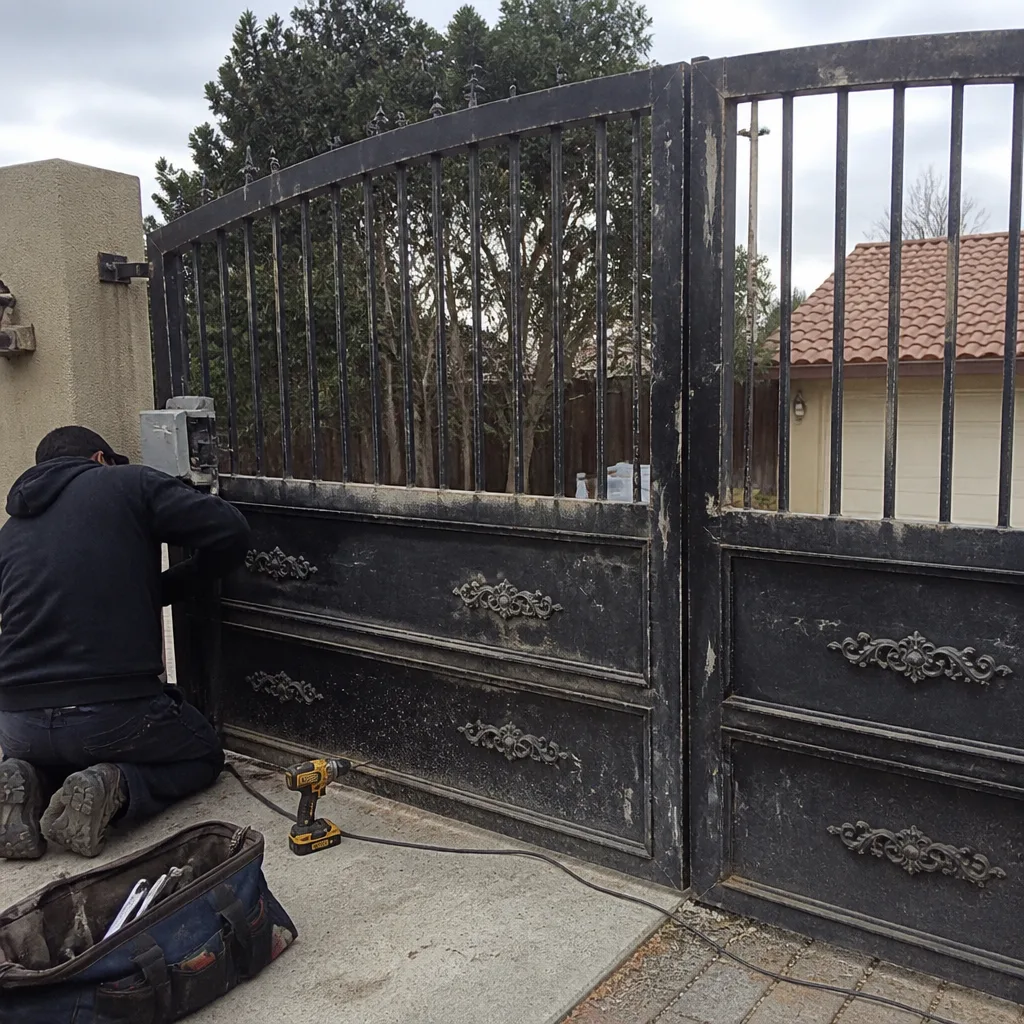 Before
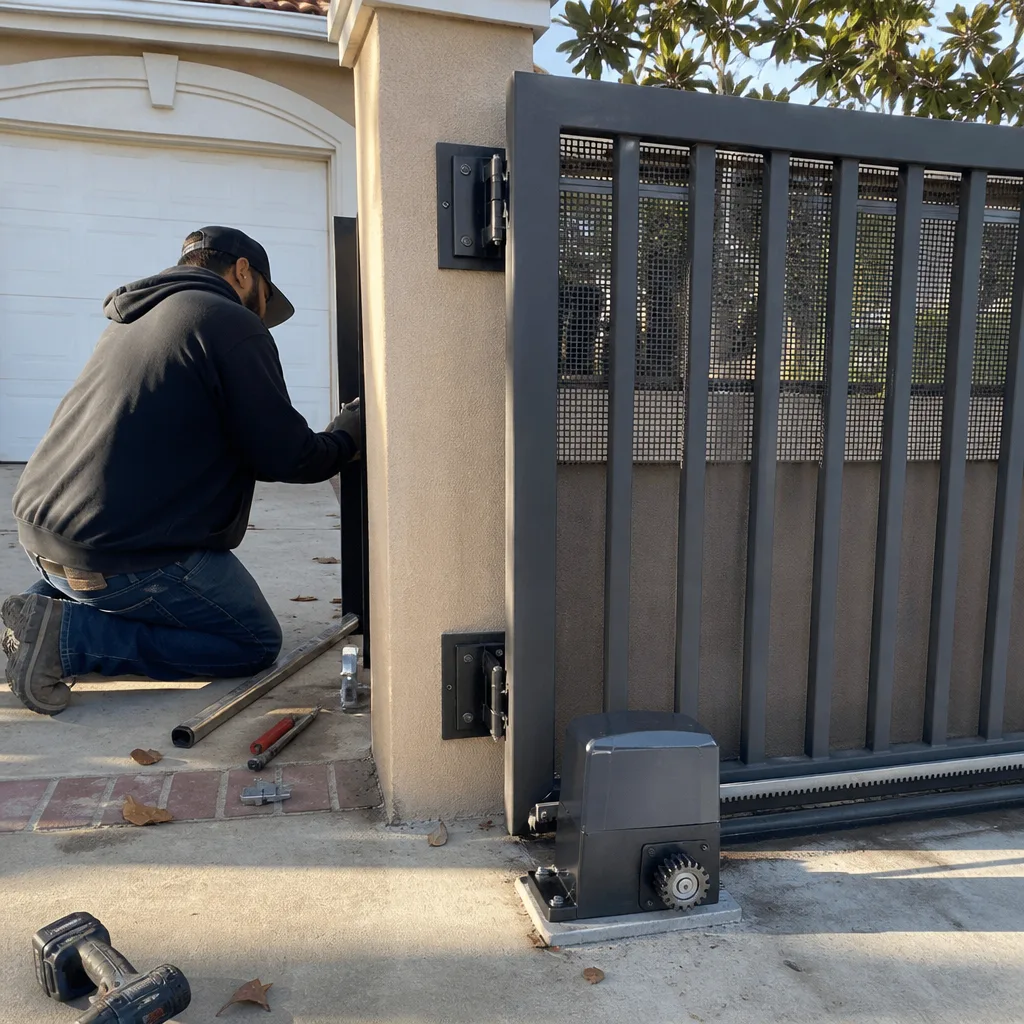 After
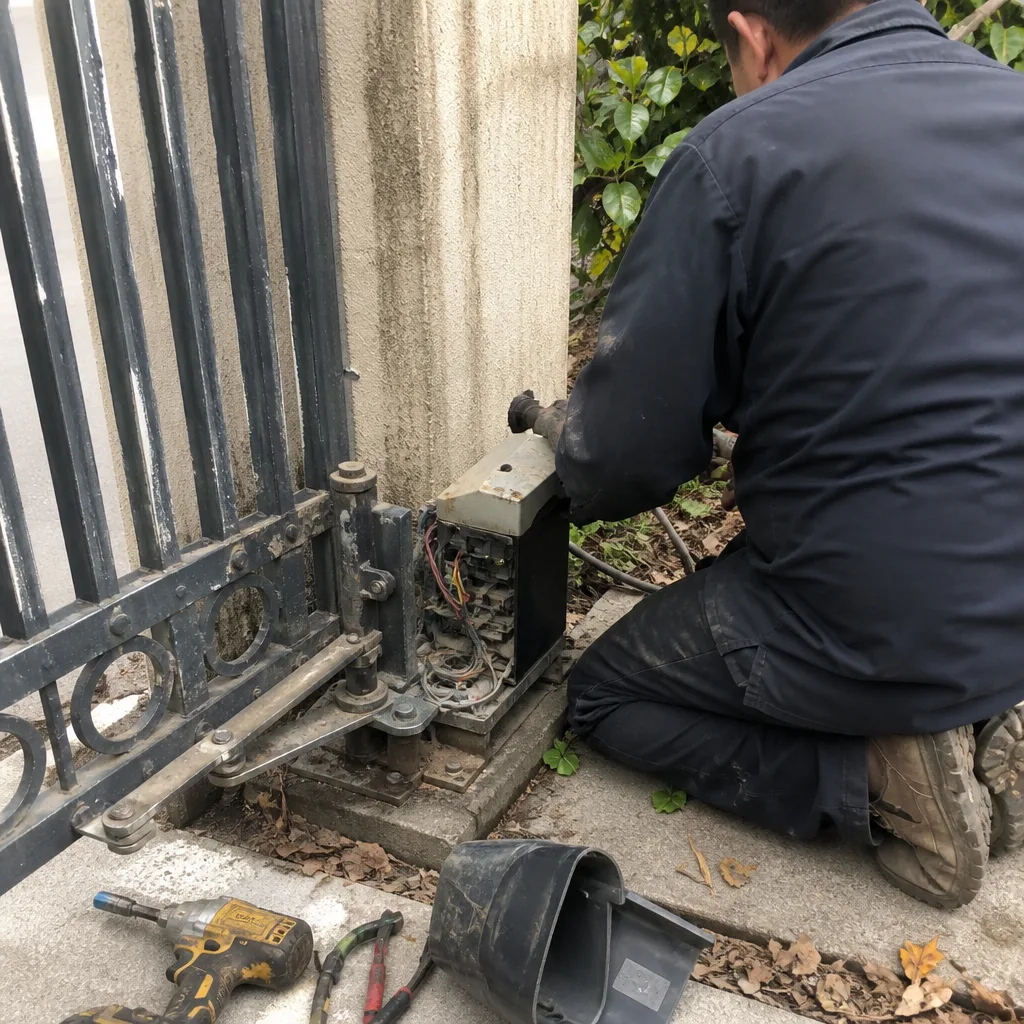 Before
 After
 Before
 After